History · first peoples to today
The voyage so far
Eighteen moments along the edge of the chart, each with the source it was checked against. Scroll, and the chart fills in beside you.
-
Time immemorial
The People of the Inside
The Duwamish, dxʷdəwʔabš, the People of the Inside, have lived here since time immemorial. They call themselves Seattle's host tribe, and they are still here.
-
Time immemorial
Across the water
Across the water, the Suquamish, named for the place of clear salt water, live on their ancestral land. Chief Seattle is buried there, facing the city that carries his name.
-
Time immemorial
The Little Crossing-Over Place
Where Pioneer Square stands, there was a winter village of about eight longhouses, Dzidzilalich, the Little Crossing-Over Place, a gathering spot for Coast Salish peoples.
-
1780s
Si'ahl
Si'ahl was born in the 1780s to a Suquamish father and a Duwamish mother. He grew up to lead both peoples, and Seattle is his name, anglicized.
-
1851
Ashore at Alki
On November 13, 1851, the schooner Exact landed a party of settlers at Alki Point, more than half of them children. It was pouring rain.
-
1853
A town named for Si'ahl
When the first town plats were filed on May 23, 1853, the settlers named their town after Si'ahl, at Doc Maynard's urging.
-
1854
The speech, and what we know of it
Si'ahl's famous 1854 speech survives only in a version Henry Smith printed in 1887 from his notes. Later rewrites invented whole passages. His real words are disputed.
-
1855
The Treaty of Point Elliott
On January 22, 1855, Si'ahl signed the Treaty of Point Elliott first. The tribes gave up most of their land and kept their right to fish.
-
1889
The Great Seattle Fire
On June 6, 1889, a glue pot caught fire in a basement cabinet shop. By sunset about 64 acres of downtown had burned, yet no one died.
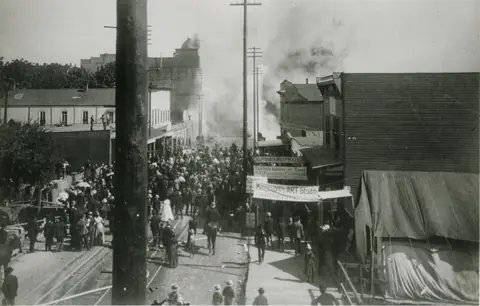
First Avenue and Madison Street, June 6, 1889. Washington State Archives, public domain. HistoryLink.org First Avenue and Madison Street on Google Maps
-
1897
A ton of gold, nearly two
On July 17, 1897, the steamer Portland docked with Klondike gold. The paper promised 'a ton'; it was nearer two, and Seattle became the gateway to the gold fields.
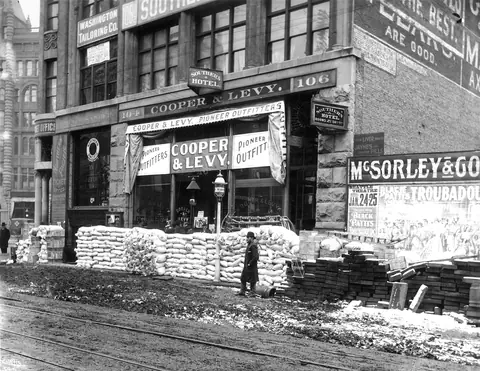
Supplies for the Klondike outside Cooper and Levy, First Avenue South, about 1897. Asahel Curtis, public domain. National Park Service The Klondike Gold Rush museum on Google Maps
-
1897–1930
Washing away a hill
Seattle found its hills inconvenient and washed some away. Between 1897 and 1930, crews sluiced Denny Hill into Elliott Bay, lowering it more than 100 feet.
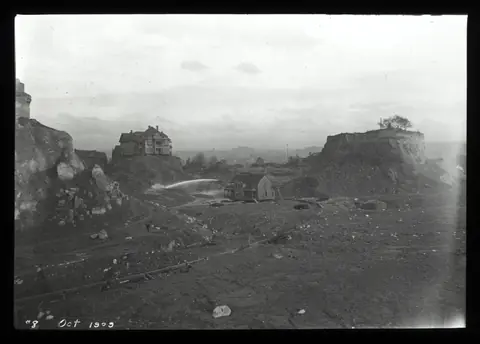
The Denny Regrade, October 1909. Seattle Municipal Archives, CC BY 2.0. HistoryLink.org Belltown, where the hill stood, on Google Maps
-
1916
Off Lake Union
In 1916 William Boeing's first airplane took off from Lake Union, and on July 15 he founded the company that became Boeing.
-
1917
The Ship Canal and the locks
On July 4, 1917, more than 200 boats paraded to dedicate the Ship Canal and the Ballard Locks. To make it work, Lake Washington was lowered nine feet.
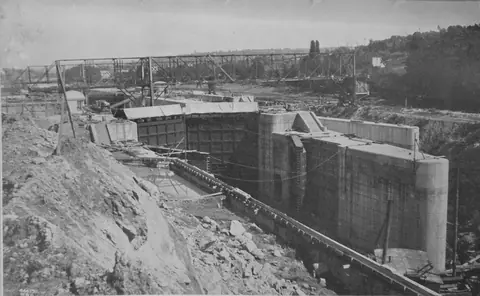
The locks under construction, about 1915. Seattle Chamber of Commerce, public domain. -
1951
Canoes, steamers, then the ferries
First canoes, then a swarm of small steamers called the Mosquito Fleet, then Black Ball ferries. On June 1, 1951, Washington State Ferries took over.
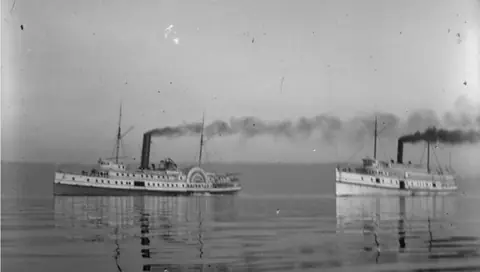
Mosquito Fleet steamers Olympian and City of Seattle racing to Tacoma, 1891. University of Washington Digital Collections, public domain. -
1962
The Century 21 World's Fair
The Century 21 World's Fair opened on April 21, 1962. Nearly 10 million visitors rode the new Monorail and went up the new Space Needle.
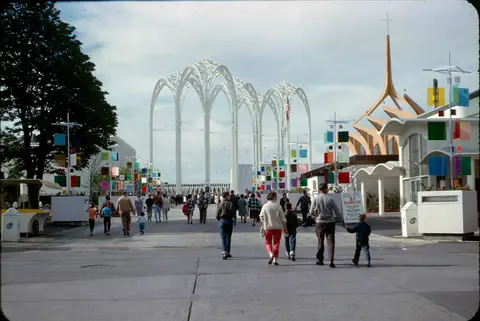
Toward the arches of the United States Science Pavilion, 1962. Seattle Municipal Archives, CC BY 2.0. -
1977
Daybreak Star
In 1970 Native activists led by Bernie Whitebear occupied surplus Army land at Fort Lawton. Their Daybreak Star Indian Cultural Center opened there in 1977.
-
2009
The Duwamish Longhouse
In 2009 the Duwamish opened their Longhouse and Cultural Center on West Marginal Way, near one of their largest old village sites. Visitors are welcome.
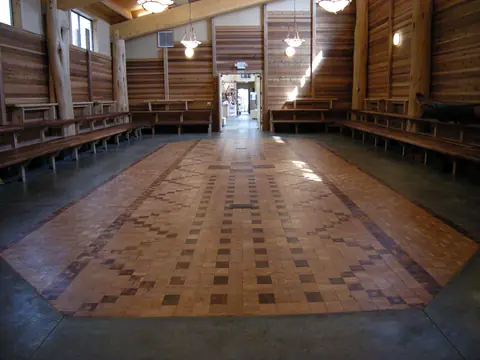
Inside the Duwamish Longhouse. Joe Mabel, CC BY-SA 3.0. -
2019–2025
The waterfront, opened up
In 2019 the waterfront highway came down. By 2025 a 20-acre park stood in its place, the city's largest civic project since the 1962 fair.
The story goes on at the water's edge. Go and see it:
Ten places to go Take the wheel